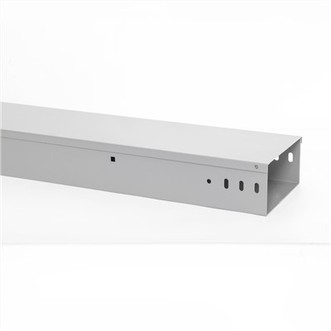
According to the purpose, the busway is generally composed of the starting busway, the straight-through busway (with jacks and without jacks), L-type vertical (horizontal) bend-through bus, Z-type vertical (horizontal) offset bus, T-type Vertical (horizontal) three-way bus, X-type vertical (horizontal) four-way bus, variable capacity busway, expansion busway, terminal head, terminal junction box, plug-in box, busway related accessories and fastening devices, etc. .
According to the insulation method, it can be divided into three types: air type plug-in busway, dense insulation plug-in busway and high-strength plug-in busway. Pneumatic Plug Busway (BMC). Because the joints between the busbars are softly connected with copper sheets, the weather in the south is humid, and oxidation is easy to occur between the joints, resulting in poor contact between the joints and the busbars, which makes the contacts easy to heat, so it is rarely used in the south. In addition, the volume between the joints is too large, the size of the horizontal busbar section is inconsistent, and the appearance is not beautiful. Densely insulated patch busway (CMC). Its moisture-proof and heat-dissipating effects are poor. In terms of moisture resistance, the busbar is prone to moisture and water seepage during construction, resulting in a drop in the insulation resistance between phases. The heat dissipation of the busbar mainly depends on the shell. Due to the compact arrangement and installation between the lines, the heat energy of the L2 and L3 phases is slowly dissipated, resulting in a high temperature rise of the busbar. The densely insulated plug-in bus duct is limited by the shell plate, and can only produce a horizontal section no larger than 3m. Due to the small air gap between the busbars, when the busbar passes a large current, a strong electric force is generated, which makes the magnetic oscillation frequency form a superimposed state, resulting in excessive noise. High strength enclosed busway (CFW). The manufacturing process is not limited by the plate, and the shell is made in the form of a tile groove, which increases the mechanical strength of the busbar, and the horizontal section of the busbar can be produced to a length of 13m. Since the shell is made of tile trenches, the busbars are intentionally separated and fixed at the position of the pits, and there is a 18mm spacing between the busbars. There is a certain gap between them, so that the temperature rise of the wire is reduced, which improves the overload capacity and reduces the magnetic oscillation noise. However, the stray current and inductive reactance generated by it are much larger than those of the dense busbar. Therefore, when comparing with the same specifications, the cross-section of its conductive row must be larger than that of the densely insulated plug-in busbar. The plug-in busway is a tree trunk system, which has the advantages of small size, compact structure, reliable operation, large transmission current, easy tap feeding, convenient maintenance, low energy consumption, good dynamic and thermal stability, etc. It is widely used in high-rise buildings. widely used.