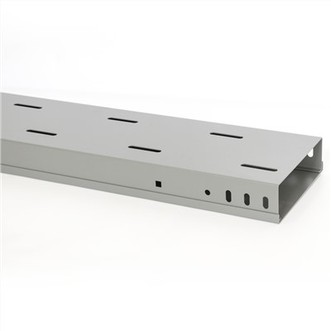
With the emergence of modern engineering facilities and equipment, the power consumption of all walks of life has increased rapidly, especially the emergence of many high-rise buildings and large workshops. The parallel use of multiple cables brings a lot of inconvenience to the on-site installation and construction connection. As a new type of distribution wire, the plug-in busbar emerges as the times require. Compared with the traditional cable, it fully reflects its superiority in the transmission of large currents. The contact resistance and temperature rise of the connection at the two ends of the slot and the insertion of the branch port, and the use of high-quality insulating materials in the busway, thereby improving the safety and reliability of the busway and making the entire system more complete.
The bus duct is a system composed of metal plates (steel or aluminum plates) as protective shells, conductive bars, insulating materials and related accessories. It can be made into standard length segments, and is equipped with plug-in junction boxes at intervals, and can also be made into feeder-type enclosed busbars without junction boxes in the middle, which brings great advantages for feeding and installation and maintenance. Great convenience.
The development of the busway according to the insulation method has gone through three generations of products: air-type plug-in busway, densely insulated plug-in busway and high-strength composite insulated plug-in busway. The busway can be set up with power conductors and protective conductors according to L+N+PE, L1+L2+L3, L1+L2+L3+N, L1+L2+L3+N+PE systems to meet the needs of electrical load.