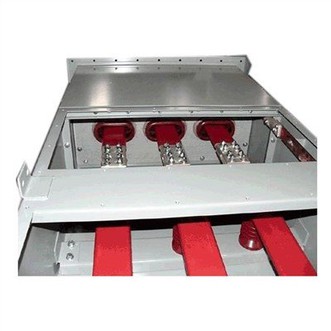
1. The heat dissipation performance of the busway is good. The insulating material of the cable (core wire insulation and outer skin insulation) is both an insulating material and a heat insulating material. Therefore, when the power cable is laid in the bridge, a maximum of 2 layers are allowed. The reason is to consider heat dissipation . The busway uses air conduction to dissipate heat, and dissipates the heat through the steel shell in close contact. Therefore, its heat dissipation performance is comparable to that of the cable, and the heat dissipation performance of the cable is evident.
2. There is almost no maintenance for the busway. The daily maintenance is usually to measure the temperature rise of the casing and the grommet bolt, the temperature rise of the joint of the incoming box, etc. If the grommet bolt is of grade 4.8, it needs to be tightened regularly. If the grade of 8.8 is used. High-strength bolts do not have to be tightened regularly. However, the cable is limited by factors such as easy wear, aging, and short life due to its material, so it needs to be inspected and maintained regularly, and even replaced.
3. The current carrying range. At present, the cable can only achieve a maximum cross-sectional area of 1000mm and a rated current of 1600A. However, this large-sized cable is rarely used in practical applications and projects because of its large size and weight. In engineering, 400 mm and The following specifications are used for power distribution, which requires many cables to supply power at the same time. The maximum rated current of the busbar can reach 6300A, and its powerful current carrying capacity is unmatched by cables.
4. The overload capacity of the bus duct is strong. It depends on the high working temperature of the insulating material used for it. The insulating material used for the bus duct is overstretched using a material with a working temperature of 105 ° C. Radiation cross-linking with a working temperature of more than 140 ° C has been developed. Flame Retardant Wrap Tape (PER) and Radiation Crosslinked Polyhydrocarbon Heat Shrinkable Tubing. The normal working temperature of the insulating material used in the cable is generally 95°C and 105°C, so the overload capacity of the busbar is much greater than that of the cable.
5. The bus duct is easy to tap. The so-called plug-in bus duct means that it uses the plug-in method to tap the power supply of the main line to the branch line, and there are plug-in box ports every several meters, so the tap is very convenient. . The cable needs to be tapped on site, which has poor reliability. Even the prefabricated branch cable has a particularly obvious disadvantage, mainly because it needs to be customized to the factory. The branch connection method adopts an open "C" type hoop. Hoop force? In addition, the price of each branch head is expensive, so the prefabricated branch cable is still not widely used. Any floor needs to cut off the power supply, and the busway does not need to be powered off, as long as the plug box of the busway is removed under no-load conditions. But to cut off the branch power of the prefabricated branch cable, it is very dangerous to operate in the case of live power.
6. The busway can prevent overload and fire. On August 27, 2000, the troubled Moscow Ostankino TV Tower in Russia, the second tallest building in the world and the tallest building in Europe, ignited a huge fire. The reason is that the cable is overloaded; Baosteel's three converters stop production, which is also caused by the cable fire. The insulating layer and outer skin of ordinary cables will burn, and flame-retardant cables will also burn under the flame. They will not burn until the flame leaves. Fire-resistant cables will not burn, but they are expensive. cable. The outer casing of the busbar is metal and will not burn. Even if the insulating material of the copper bar burns, the flames will not escape to the outside of the busbar.